Address
304 North Cardinal
St. Dorchester Center, MA 02124
Work Hours
Monday to Friday: 7AM - 7PM
Weekend: 10AM - 5PM
Address
304 North Cardinal
St. Dorchester Center, MA 02124
Work Hours
Monday to Friday: 7AM - 7PM
Weekend: 10AM - 5PM
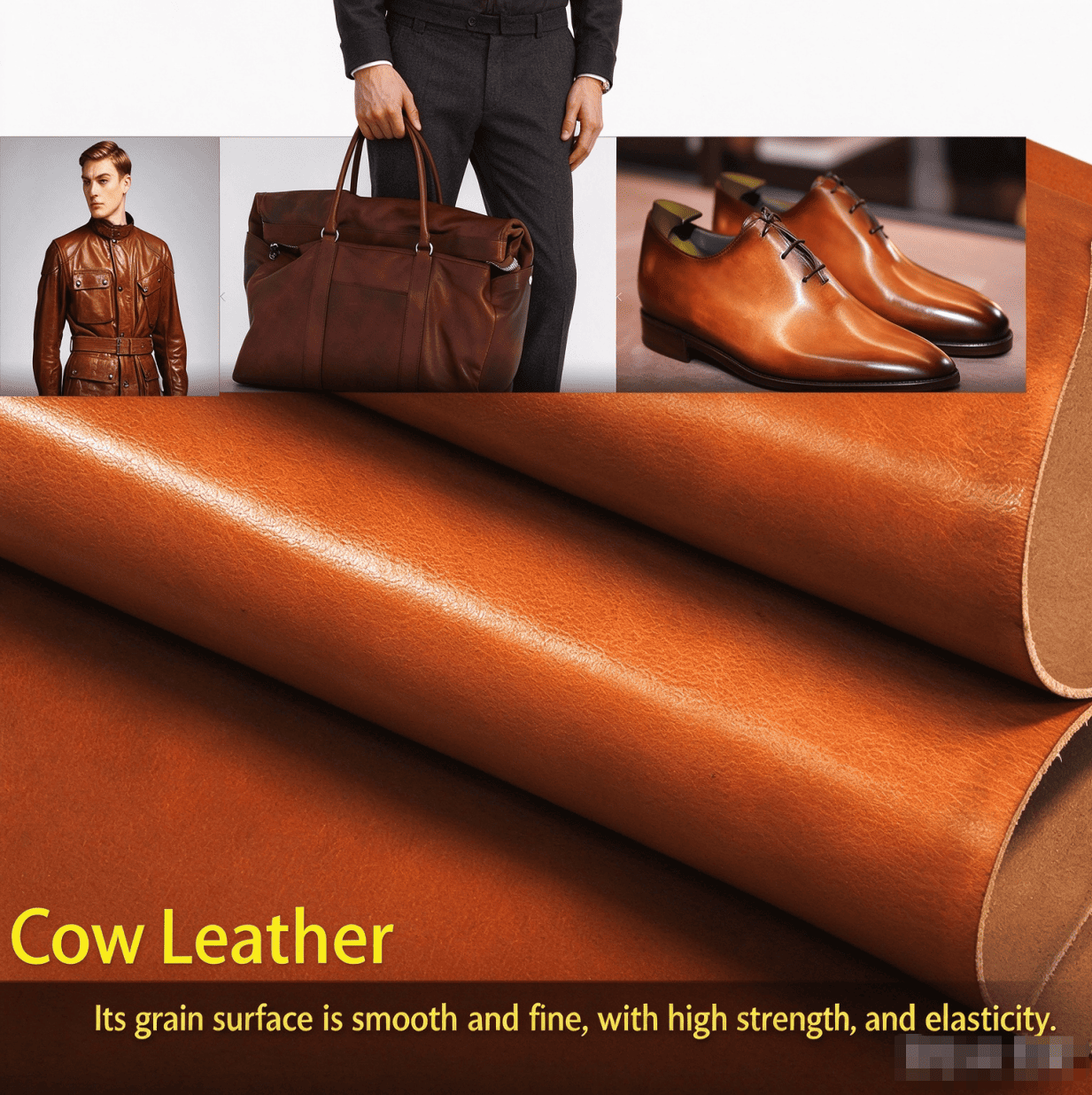
Buying a leather bag sounds simple until you start reading the product description.
“Genuine leather.” “Full-grain leather.” “Top-grain.” “Split leather.” “PU leather.” “Faux leather.”
They can all sound similar when you are simply looking for a good-looking bag. But they are not describing the same thing. In fact, two bags that look almost identical in photos can be made from very different materials.
And that matters. The material affects how a bag feels in your hand, how it ages, how it reacts to scratches and moisture, and how long it may stay looking good.
Whether you’re comparing everyday handbags, designer handbags, luxury handbags, or a simple leather wallet, knowing a few basic terms can help you make a much better buying decision.
So let’s clear up the confusion without turning this into a leather textbook.
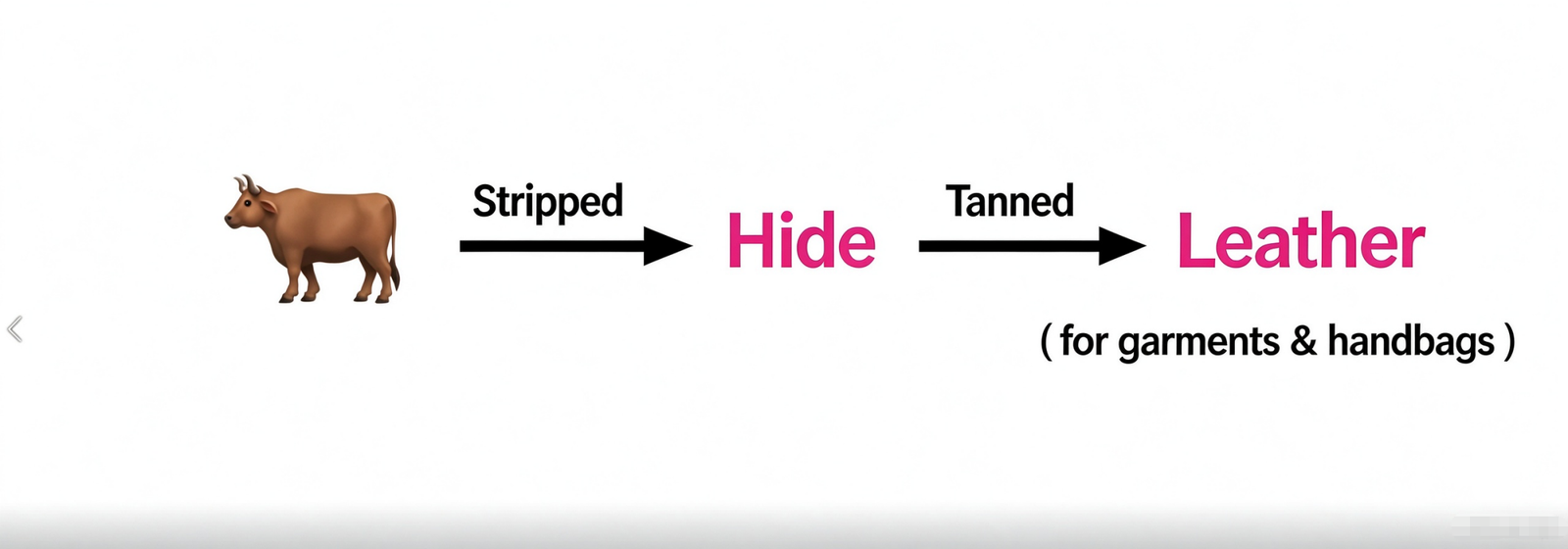
The first thing to understand is surprisingly simple: not everything that looks like leather is actually leather.
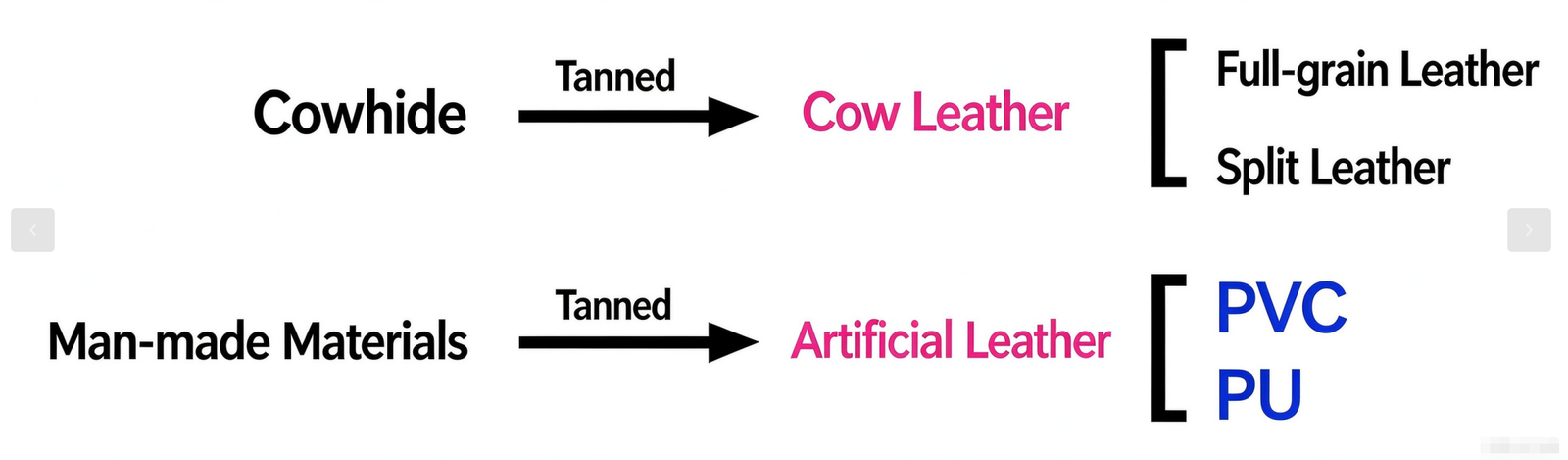
Natural leather starts with animal hide. Cowhide is one of the most commonly used materials for bags because it offers a useful balance of strength, flexibility, texture, and durability. Calfskin, lambskin, goatskin, and other types of hide are also used depending on the style and purpose of the bag.
Synthetic leather is different. It is manufactured from materials such as polyurethane (PU), PVC, or other synthetic coatings and fabrics designed to reproduce the appearance and feel of leather.
Real animal leather has a natural fiber structure. Even after tanning and finishing, you may still see small variations in grain, pores, wrinkles, or texture.
That variation is actually one of the interesting things about natural leather.
If you buy two bags made from natural hide, they may not look perfectly identical. One piece may have a slightly different grain or a small natural mark from another. That does not automatically mean something is wrong with the leather.
In fact, many people like leather precisely because it develops its own character over time.
Faux leather is manufactured to imitate natural leather. PU and PVC are two common examples.
A good synthetic material can look surprisingly convincing. It can also have some practical advantages. It may be less expensive, easy to clean, and suitable for shoppers who prefer not to use animal-derived materials.
The important point is simply to know what you are buying.
A bag that is made from PU should not be presented as if it were made from full-grain cowhide. They are different materials, even if the finished surface looks almost the same.
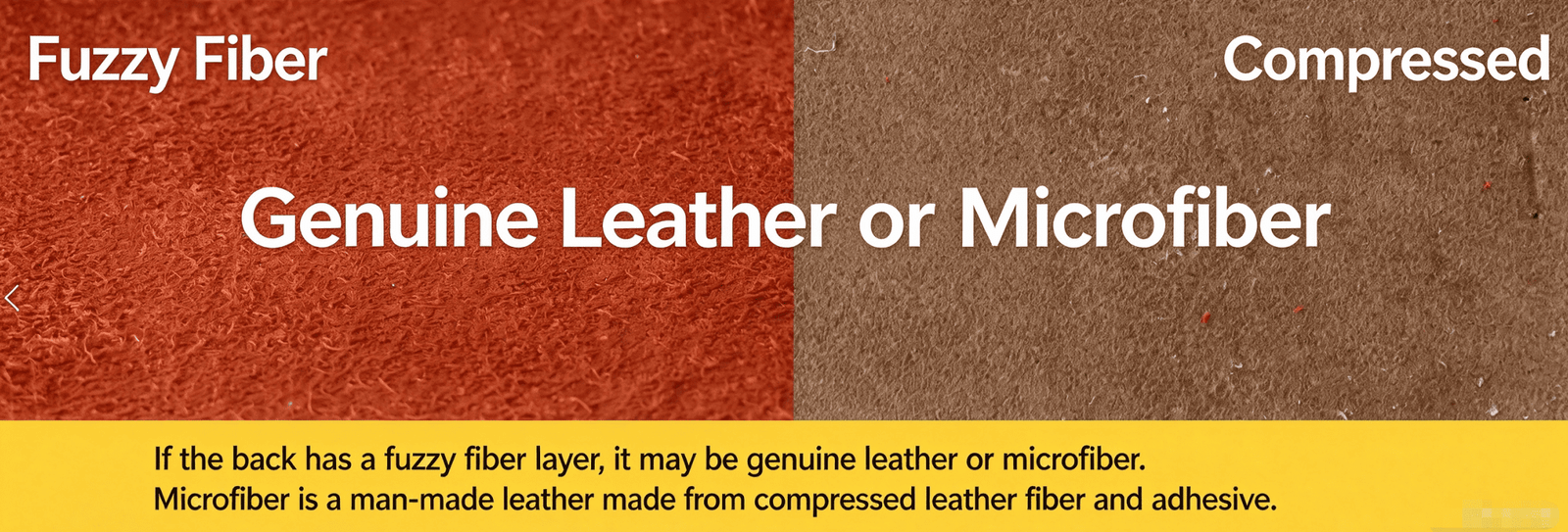
This is one of the easiest mistakes to make when shopping online.
A photograph mainly shows you the surface of the bag. It doesn’t necessarily tell you what is underneath.
Embossing can create a convincing grain pattern. Coatings can make a surface smooth and glossy. Finishes can change the color and texture dramatically.
So instead of asking only, “Does this look like leather?” ask a second question:
“What is the material actually made from?”
The term “genuine leather” causes a lot of confusion.
Some shoppers see those words and assume they mean “the best leather available.” That’s not what the term means.
In everyday product descriptions, genuine leather generally means that the material is made from real animal hide rather than being entirely synthetic.
But genuine leather is not a premium quality ranking.
This is worth remembering.
A product can be made from genuine leather and still use a lower layer of a hide, extensive surface treatment, or other processing. On the other hand, a product described more specifically as full-grain leather gives you additional information about the part of the hide being used.
Think of these terms as answering different questions.
“Genuine leather” is mainly telling you about the source of the material.
“Full-grain leather” tells you more about the structure and portion of the hide that has been used.
They are not two competing grades where one simply means “better.”
This distinction becomes especially useful when you are comparing Designer bags or trying to understand why two bags with similar designs can have very different prices.
Faux leather is not animal leather. It is a manufactured material designed to reproduce some of the visual and tactile qualities of leather.
PU leather is a common example. PVC is another.
There is nothing inherently wrong with choosing synthetic leather. It may be exactly what a shopper wants. The problem starts when the description makes the material sound more premium or more natural than it really is.
A transparent product description should tell you what the bag is made of rather than relying on vague marketing language.
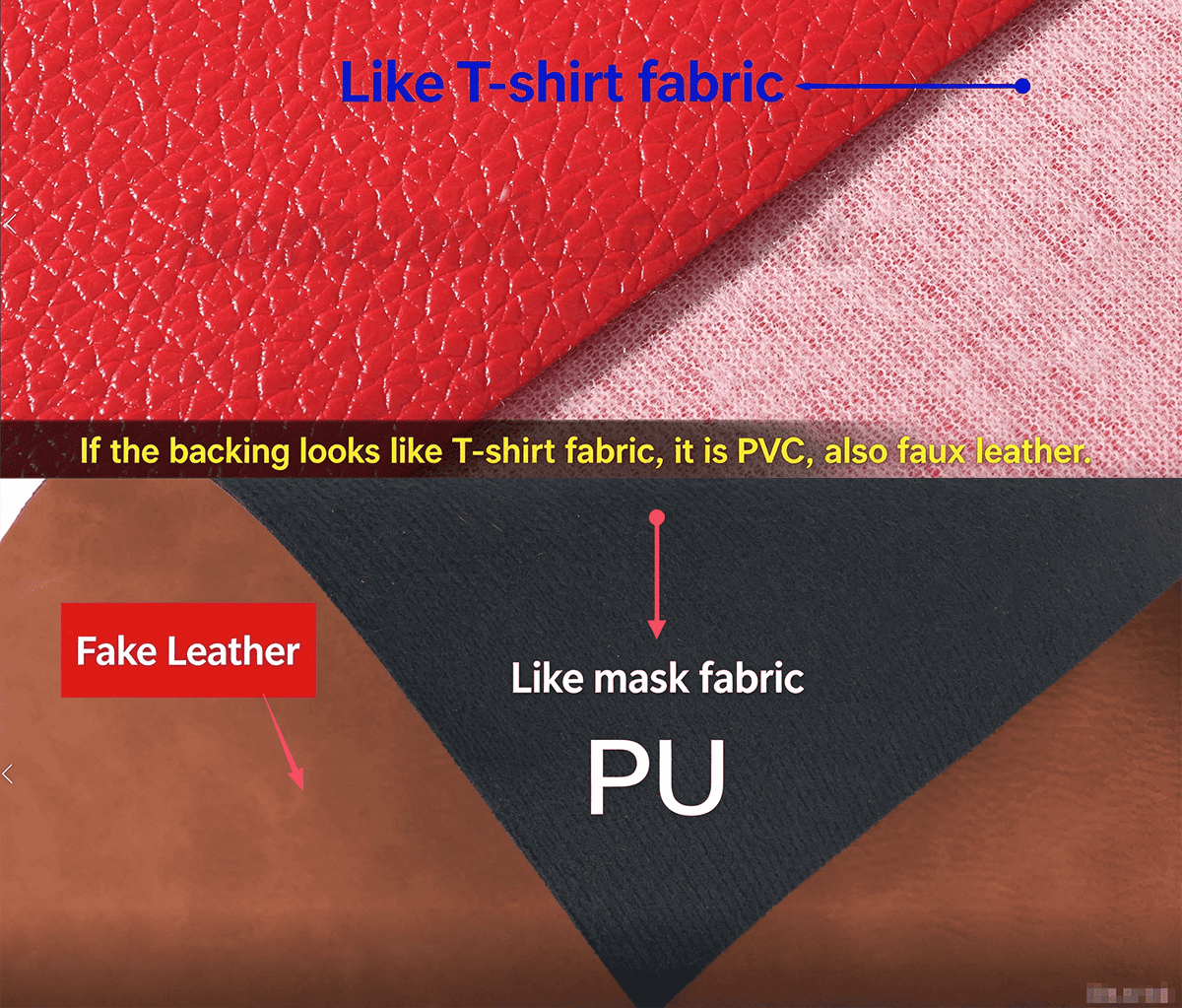
Now we get to the part that causes perhaps the most confusion: full-grain leather versus split leather.
Imagine a cowhide as a layered material rather than one completely uniform sheet.
Once the hide is processed and split into layers, the different sections can have noticeably different characteristics.
Full-grain leather generally retains the natural grain surface of the hide.
This outer part of the hide has a relatively dense and strong fiber structure. Because the natural grain is preserved, the surface can show pores, subtle wrinkles, natural markings, and variations in texture.
Those characteristics are often considered part of the appeal of high-quality leather.
Full-grain leather is commonly valued for:
But there is an important caveat: full-grain does not automatically mean that every part of the finished bag is excellent.
The quality of the original hide, tanning, thickness, construction, stitching, hardware, lining, and workmanship all matter too.
Top-grain leather also comes from the upper portion of the hide, but the surface may be corrected, sanded, or otherwise treated to create a more consistent appearance.
This can be useful when a manufacturer wants a cleaner and more uniform finish.
Top-grain leather can still offer very good durability and a pleasant feel, and it is widely used in quality leather products.
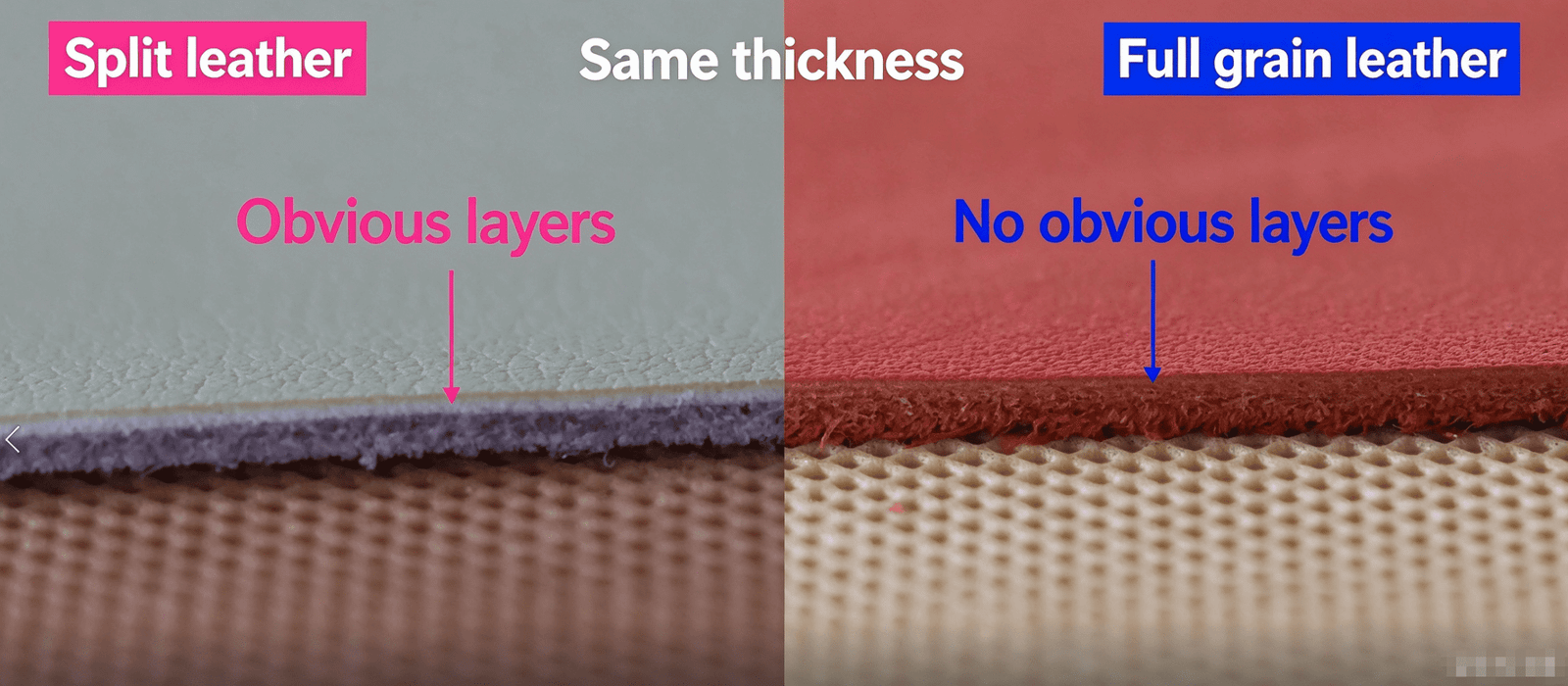
When a hide is separated into layers, the lower portion is commonly known as split leather.
This is what shoppers often mean when they talk about “second-layer leather” .
Split leather is still genuine animal leather. That point is important.
The difference is that it does not contain the same natural grain surface found on full-grain leather.
Because the surface of split leather is different, manufacturers may use coatings, embossing, pigmentation, or other finishing techniques to create the desired appearance.
A well-finished split leather bag can still look attractive and work perfectly well for its intended purpose. The mistake is assuming that “real leather” automatically means “full-grain leather.”
Let’s say you find two bags that look almost identical online.
One uses a higher-grade grain leather. The other uses split leather with a finished or embossed surface.
Both may legitimately contain real leather.
But the raw material, processing, appearance, durability, and aging characteristics can be quite different.
That’s why the phrase “100% leather” doesn’t tell the whole story.
Instead of asking:
“Is this bag real leather?”
try asking:
“What type of leather is used, and which part of the hide does it come from?”
That question will usually get you a much more useful answer.
There is another distinction that is easy to miss.
The type of leather and the way the leather is finished are two separate things.
One tells you about the material. The other tells you about what was done to the material.
Terms such as these generally tell you something about the material itself:
For example, calfskin is generally known for a fine, smooth feel, while heavier cowhide can provide a more structured and durable character.
Neither is automatically “better.” It depends on what kind of bag you want.
Now consider terms such as:
These terms are mainly talking about the surface appearance or finishing process.
For instance, a pebbled texture may be natural in some leather but embossed or created through finishing in another. A smooth surface doesn’t automatically mean the leather is higher quality, either.
This is why simply touching the surface or looking at a photograph isn’t always enough to identify the underlying leather.
There are really two separate questions:
Question 1: What is it?
Cowhide? Calfskin? Full-grain? Split leather? Synthetic material?
Question 2: What has been done to it?
Embossed? Coated? Sanded? Pigmented? Polished? Printed?
Once you separate those two questions, leather descriptions become much easier to understand.
Think about familiar styles such as a Louis Vuitton bag, Chanel handbags, Gucci handbags, Coach handbags, YSL bags, or Prada handbags.
People naturally pay attention to the silhouette, logo, hardware, stitching, and overall design. Those things matter, but the material can completely change the feel and character of a bag.
Even within a single style, different leather choices can create very different results.
A structured leather may make a bag feel polished and formal. A softer leather can give the same basic shape a more relaxed look.
The same principle applies when looking at women’s designer bags or comparing designer bags dupes. A similar shape does not necessarily mean similar materials or construction.
Take examples such as the Hermes Birkin, Hermes Kelly, Gucci Marmont, or LV Neverfull.
The name and design are only part of the story.
Different leather types and finishes can make a bag feel completely different in the hand. A softer leather may drape differently, while a more structured leather may hold its shape better.
So if you’re comparing an original luxury piece with a lower-priced alternative, don’t stop at the question of whether they “look the same.”
Look at the material, construction, hardware, stitching, lining, and finishing as well.
You don’t need to become a leather expert before buying a bag.
Just ask these five questions.
Look for a clear material description.
If the product says genuine leather, that generally indicates animal leather. If it says PU or PVC, you are looking at a synthetic material.
If the seller provides the information, check whether the leather is full-grain, top-grain, or split.
If the description simply says “leather,” don’t automatically assume it means full-grain.
Embossing, coating, pigmentation, and other finishing processes can dramatically change the appearance of leather.
A very smooth or perfectly uniform surface isn’t necessarily a sign of higher quality.
A high price doesn’t automatically mean better leather.
Part of the price may come from the brand, design, hardware, craftsmanship, marketing, scarcity, or simply the popularity of the style.
Material quality is important, but it is only one part of the final price.
This is probably the most practical question of all.
If you carry your bag every day, you may want something durable and relatively easy to maintain.
If you’re buying a bag for occasional use, you may care more about softness, appearance, or a particular finish.
There isn’t one perfect leather for everyone.
The easiest way to remember everything is to separate the terminology into four simple questions.
This tells you about the basic source of the material.
This generally tells you that the material is genuine animal leather, but it does not automatically tell you that it is premium or full-grain.
This gives you more information about which part of the hide is being used and how much of the natural grain has been retained.
This mainly tells you about the surface appearance and finishing process.
These are different dimensions. Mixing them together is what makes leather terminology seem much more complicated than it really is.
Buying a leather bag doesn’t need to be complicated.
You don’t have to memorize every leather term or become an expert in tanning.
Just remember the basics.
Leather comes from animal hide, while synthetic or faux leather is manufactured from other materials.
Genuine leather generally confirms that you’re dealing with real leather, but it does not automatically mean the highest grade.
Full-grain leather retains the natural grain surface of the hide, while split leather comes from a lower layer after the hide has been separated.
And words such as smooth, pebbled, embossed, coated, suede, and nubuck mainly describe the surface or finishing rather than the original source of the hide.
Once you understand those differences, shopping becomes much easier.
Whether you’re looking for everyday handbags, luxury handbags, designer crossbody bags, or a classic wallet, don’t judge a bag only by its appearance.
Look underneath the surface.
That is often where the real difference in quality begins.


[…] Leather, Genuine Leather, Full-Grain or Split Leather? How to Buy a Bag Without Getting Fooled Understand common leather terms before choosing your next bag. […]
[…] Full-Grain vs. Split Leather: Practical Ways to Tell the Difference7 Common Ways to Tell Real Leather from Faux Leather — But How Reliable Are They?Leather, Genuine Leather, Full-Grain or Split Leather? How to Buy a Bag Without Getting Fooled […]
[…] If you want to learn more about leather terminology, read our guide Leather, Genuine Leather, Full-Grain or Split Leather? How to Buy a Bag Without Getting Fooled. […]
[…] For a broader introduction to leather grades and finishes, read Leather, Genuine Leather, Full-Grain or Split Leather? How to Buy a Bag Without Getting Fooled. […]
[…] For more guidance on materials and construction, see Leather, Genuine Leather, Full-Grain or Split Leather? How to Buy a Bag Without Getting Fooled. […]