Address
304 North Cardinal
St. Dorchester Center, MA 02124
Work Hours
Monday to Friday: 7AM - 7PM
Weekend: 10AM - 5PM
Address
304 North Cardinal
St. Dorchester Center, MA 02124
Work Hours
Monday to Friday: 7AM - 7PM
Weekend: 10AM - 5PM
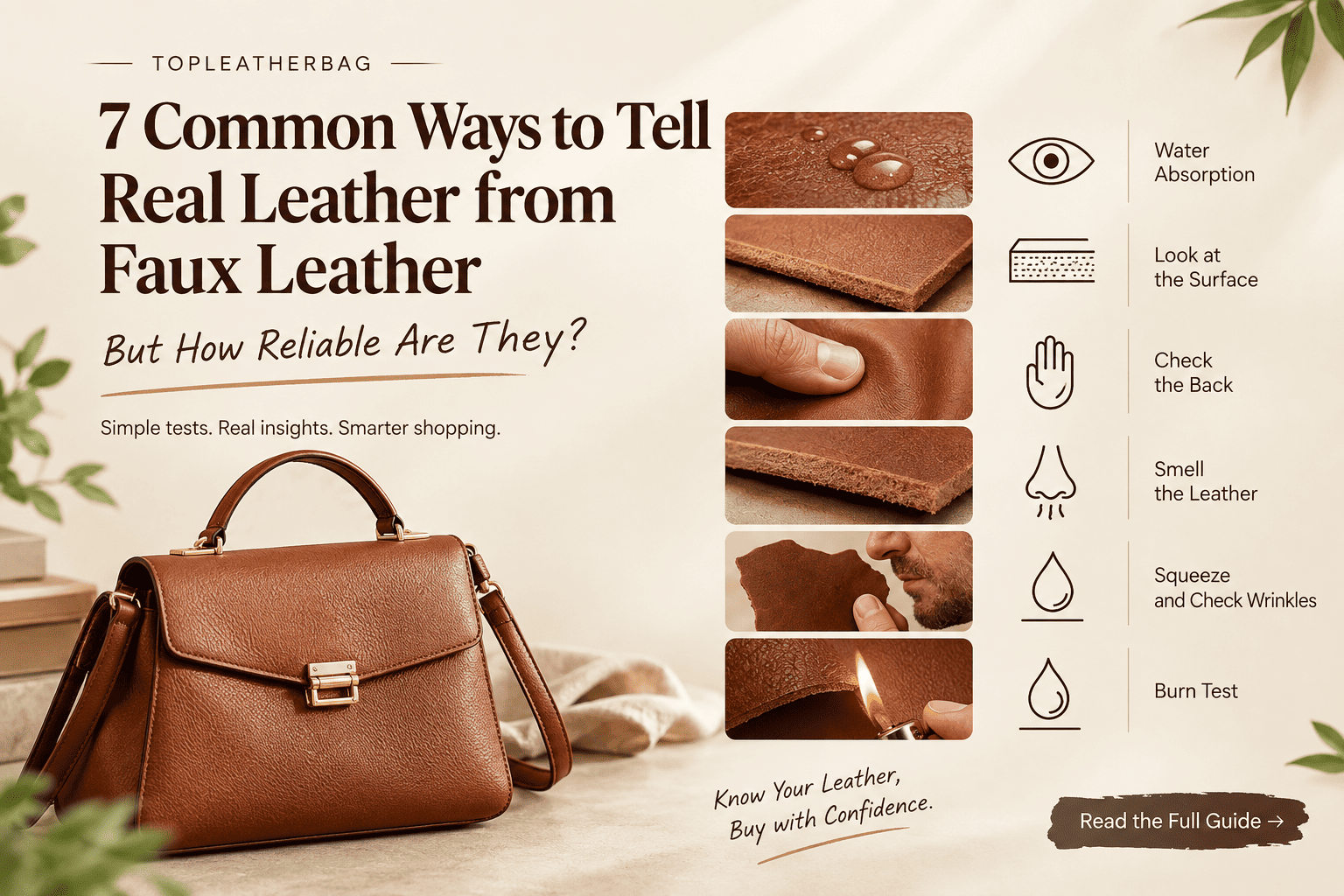
When shopping for a leather bag, one of the first questions many people ask is simple: Is this actually real leather?
There are plenty of tricks online that claim to help you find the answer. Some people recommend putting a drop of water on the leather. Others say you should examine the surface, look at the back, smell it, squeeze it, or even hold a lighter to it.
But how reliable are these methods in real life?
The truth is that some of these tests can give you useful clues, but very few can prove the answer on their own. Modern PU and PVC materials can look surprisingly realistic, while genuine leather can also be coated, embossed, dyed, or treated to change its natural appearance.
If you are shopping for Designer bags, leather wallets, or other leather goods, it is better to combine several observations instead of relying on one “magic test.”
So let’s go through seven of the most common methods and see how useful each one really is.
| Test | Reliability | Main Problem |
|---|---|---|
| Water drop test | ★★☆☆☆ | Surface coatings can affect the result |
| Looking at the surface | ★★★☆☆ | Artificial grain can look very realistic |
| Looking at the back | ★★★★☆ | You need to find a genuinely untreated area |
| Looking at the cross-section | ★★★★★ | Very useful, but you cannot normally cut up a finished bag |
| Smelling the leather | ★★★☆☆ | Tanning, coatings, and fragrances can change the smell |
| Squeezing the leather | ★★★★☆ | Different leather types behave differently |
| Burn test | ★★★★☆ for material samples | Destructive and unsuitable for finished bags |
One important point before we start: “reliable” does not mean “conclusive.” Even a useful test can sometimes produce a misleading result. The best approach is to look at several characteristics together.
Verdict: It can provide a clue, but it is not reliable enough to prove that leather is genuine.
This is probably one of the most popular leather tests on the internet.
The idea is simple. Put a small drop of water on the leather and watch what happens.
The traditional explanation goes like this:
There is some truth behind this idea.
The problem is that modern genuine leather can also have surface coatings and water-resistant treatments. A well-finished leather bag may prevent water from penetrating quickly. That does not suddenly make it synthetic.
On the other hand, some synthetic materials may also behave differently depending on their surface finish.
So if you put a drop of water on an expensive leather bag and the water stays on the surface, that alone does not prove that the bag is fake.
If the seller allows you to test the material, a hidden area is safer than the main body of the bag. But even then, treat the result as one piece of evidence rather than a final answer.
Reliability: ★★☆☆☆
Verdict: Yes, it can help, but surface appearance alone is not enough.
Natural leather comes from animal hide, so it does not naturally look perfectly uniform from one area to another.
Depending on the type of leather, you may notice:
Some synthetic leather, by contrast, gets its grain from embossing or printing. If you look closely, you may notice that the same pattern repeats again and again.
But there is an important catch.
Real leather can also be embossed.
Manufacturers sometimes emboss genuine leather to create a more consistent appearance. So a very regular grain pattern does not automatically mean that the material is fake.
At the same time, today’s high-quality synthetic leather can look remarkably realistic. A quick glance in a store is often not enough to tell the difference.
Rather than asking whether the surface looks “perfect,” pay attention to whether the grain looks excessively repetitive or artificial.
If exactly the same pattern appears over and over again in a mechanical-looking way, it may be worth taking a closer look at the material.
Reliability: ★★★☆☆
Verdict: Usually more useful than looking only at the front.
Why?
The front of faux leather is specifically designed to imitate the appearance of real leather. The back can sometimes reveal more about what the material is actually made of.
On an untreated piece of genuine leather, the back may show a natural fibrous or suede-like structure.
Many PU and PVC materials, however, are made with a surface coating attached to a fabric or other backing material. When you look at the reverse side, the textile-like backing may be easier to see.
But again, there are exceptions.
Some genuine leather is sanded, bonded, finished, or otherwise processed. A finished handbag may also have lining, reinforcement, or other layers that prevent you from seeing the actual back of the leather.
When inspecting a leather bag, useful places to check include:
These areas can sometimes tell you more than the main front surface of the bag.
Reliability: ★★★★☆
Verdict: If you can see a genuine, untreated cross-section, this is one of the most useful methods.
The cross-section can reveal the internal structure of the material, which makes it more informative than simply looking at the surface.
Natural leather has a complex natural fiber structure. When viewed from the edge, it generally does not look exactly like a uniform sheet of plastic.
With some synthetic leather, you may be able to see a more obvious layered construction, such as a PU or PVC surface layer attached to a textile backing.
This is one reason why examining leather edges and cross-sections can be useful when identifying materials.
Of course, there is a practical problem for ordinary shoppers:
Who is going to cut open a handbag just to find out whether it is genuine leather?
You certainly should not.
Instead, look for areas where the cross-section is already visible, such as:
If the exposed edge shows a natural fibrous structure, that can be much more informative than simply smelling the bag.
There is another important distinction, though.
Seeing genuine leather in the cross-section does not automatically mean that the product is made from full-grain or top-grain leather.
“Genuine leather” is not synonymous with “full-grain leather.” When buying a higher-end leather product, it is worth learning what type and grade of leather is actually being used.
Reliability: ★★★★★
Verdict: Useful as a supporting clue, but definitely not proof.
Many people associate genuine leather with a distinctive leather smell.
And yes, real leather can have a characteristic smell after tanning. But the final scent depends on many things, including the tanning process, dyes, finishing products, coatings, storage conditions, and even the age of the product.
Some natural leather may have a warm, earthy, animal-hide-like scent. Synthetic materials may sometimes have a stronger plastic, rubber, or chemical smell.
But there is an obvious problem:
Smell can be changed.
Heavily finished genuine leather may have very little natural leather smell left. Synthetic leather can also be manufactured with fragrances designed to imitate the smell of genuine leather.
So smelling a bag and thinking, “This smells like leather,” is not enough to establish that it is genuine.
A better approach is to treat a strong plastic or chemical smell as a possible warning sign, while remembering that a pleasant “leather smell” is not proof of authenticity.
Reliability: ★★★☆☆
Verdict: One of the more useful non-destructive tests.
Leather is a natural material, so gently squeezing it can reveal something about its structure and flexibility.
When you lightly press or pinch genuine leather, it often develops soft, irregular wrinkles. Once you release it, the material gradually returns toward its original shape.
Some synthetic materials can feel more plastic-like. They may either feel unusually stiff or form sharper, more artificial-looking creases.
But there is an important warning here:
“Bounces back quickly = real leather” is not a reliable rule.
Different leather types have different thicknesses, tanning methods, coatings, and structures. A thick leather will naturally behave differently from a soft, lightweight leather.
Instead of focusing only on how quickly it returns to shape, look at how the wrinkles form.
When gently squeezed, does the material develop soft, natural-looking folds, or does it behave more like a plastic sheet?
This is a particularly convenient test when shopping for handbags, wallets, and other leather goods because it does not normally damage the product.
Reliability: ★★★★☆
Verdict: It can provide useful information when testing a loose material sample, but it is a poor choice for a finished handbag.
You may have seen the following advice online:
There is a material-science reason why heat can reveal differences between natural leather and synthetic polymers. Their compositions are different, so they react differently to high temperatures.
But there is one very obvious problem:
You can damage the product.
If you are examining a Louis Vuitton bag, Chanel handbags, Prada handbags, YSL bags, or another expensive leather product, taking out a lighter is obviously not a sensible way to verify the material.
Even if you own the bag, there is little reason to leave a burn mark simply to satisfy your curiosity.
A burn test makes more sense when you are testing a small piece of raw material, a production sample, or a leather offcut that you do not need to preserve.
So the reliability depends on the situation:
For a loose material sample: ★★★★☆
For a finished handbag: ★☆☆☆☆
By now, you may have noticed a pattern.
Almost every test has exceptions.
Water absorption can be affected by coatings. Grain can be embossed. The back can be finished. Smell can change over time. Different leather types have different flexibility. And a burn test can permanently damage the product.
That is why there is no single “magic trick” that can identify every piece of leather with complete certainty.
This is especially important today because genuine leather itself comes in many different forms.
Full-grain leather, top-grain leather, corrected-grain leather, split leather, bonded leather, and synthetic leather are all different materials or constructions with different characteristics.
So instead of asking only:
“Is this real leather?”
It is better to ask:
“What type of leather is it?”
“What grade is it?”
“Has the surface been coated or embossed?”
These questions usually tell you much more about the product.
If you are shopping in a store or inspecting a bag after receiving an online order, try this simple step-by-step approach.
Look at the grain. Does it appear naturally varied, or is exactly the same pattern repeated everywhere? Does the material have an overly plastic-looking shine?
This can be one of the most useful steps. Look for a hidden edge, the underside of a strap, or an area where the material is not completely covered.
Pay attention to the thickness, flexibility, texture, and the way wrinkles form. Don’t judge the material simply by whether it feels soft.
Use the smell as supporting evidence, not as proof.
If you have permission to test the material, use a hidden area and remember that water resistance does not automatically mean the material is synthetic.
For a more expensive leather product, the material description, specifications, and seller’s answers can be much more useful than a single internet trick.
If you are learning how to choose a bag that suits your needs, you can also explore our How to Choose a Designer Bag for more practical tips on materials, styles, sizes, and everyday use.
If you only want to remember a few methods, I would focus on these three:
These methods are useful because they normally do not require damaging the product.
The water test and smell test can be used as supporting clues. A burn test is better reserved for loose material samples rather than finished handbags.
This is probably one of the most important things to remember when shopping for a leather bag.
“Real leather” only tells you that the material contains genuine leather. It does not automatically tell you how good the leather is.
A genuine leather bag can be made from different grades of leather and can undergo different levels of sanding, embossing, coating, and finishing.
So don’t stop at the words “Genuine Leather” when evaluating a leather product.
If you are shopping for designer handbags, luxury handbags, or women’s designer bags, look at the leather type, leather grade, construction, stitching, hardware, lining, and overall craftsmanship as well.
The same principle applies when comparing designer bags dupes or designer crossbody bags. Two bags can look almost identical while using completely different materials and construction methods.
The smartest shopper isn’t the person who knows the most “secret leather tricks.” It is the person who knows how to combine several small clues and look at the whole product.
If the surface looks natural, the exposed edge has a convincing structure, the material feels right, the smell is normal, and the seller can clearly explain what type of leather was used, that gives you much more confidence than a single water-drop test ever could.
At the end of the day, identifying leather isn’t about memorizing one “secret test.” The most reliable approach is to combine material structure, surface characteristics, texture, flexibility, and product information.
Whether you’re considering a Louis Vuitton bag, Chanel handbags, Gucci Marmont, LV Neverfull, or a more affordable leather bag, learning to look at the material carefully can help you make a much more informed decision.


[…] 7 Common Ways to Tell Real Leather from Faux Leather […]