Address
304 North Cardinal
St. Dorchester Center, MA 02124
Work Hours
Monday to Friday: 7AM - 7PM
Weekend: 10AM - 5PM
Address
304 North Cardinal
St. Dorchester Center, MA 02124
Work Hours
Monday to Friday: 7AM - 7PM
Weekend: 10AM - 5PM
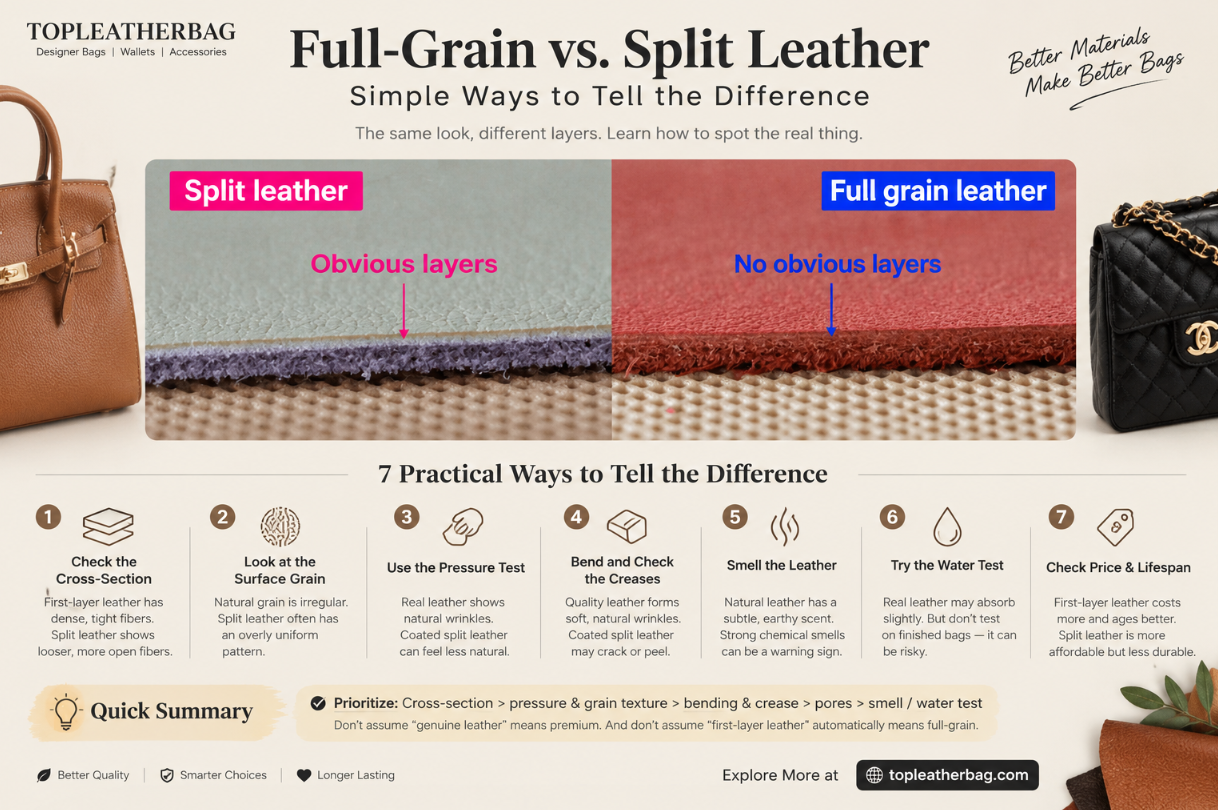
When shopping for a leather handbag, the words “genuine leather,” “top grain,” “full grain,” and “split leather” can quickly become confusing. Two bags may look almost identical in product photos, yet feel completely different in your hands and age very differently after a few years of use.
One of the most useful things to understand is the difference between first-layer leather and split leather. In simple terms, the first layer comes from the grain side of the hide, where the fibers are tighter and the natural surface is found. Split leather comes from the lower layer after the grain side has been separated.
That doesn’t mean every first-layer leather product is automatically premium. Full-grain leather, top-grain leather, and corrected-grain leather can all start from the grain layer, but the amount of surface processing can be quite different. Split leather, meanwhile, often needs an artificial finish, coating, or embossed grain pattern to create a smooth leather-like surface.
If you are comparing a Louis Vuitton bag, Chanel handbags, Gucci handbags, Coach handbags, YSL bags, Prada handbags, or even a pre-owned Hermes Birkin or Hermes Kelly, understanding the material underneath the surface can help you make a much more informed decision.
Here are the most practical ways to tell the difference.
If you have access to an exposed edge or a genuine leather sample, checking the cross-section is one of the most useful tests.
First-layer leather generally has a relatively dense and compact fiber structure. The fibers close to the grain side are tightly organized, which is one reason this part of the hide is naturally stronger.
Split leather comes from the lower portion of the hide. Once the grain layer has been removed, the remaining fibers are more open and less tightly packed.
On a finished handbag, you may be able to inspect the edge around a cut, an unfinished interior edge, a punched hole, or another exposed area. A natural-looking, dense fiber structure is a positive sign. If the surface looks like a very thin artificial skin sitting on top of a softer, fibrous material, it may indicate coated split leather.
Important: many high-quality handbags have painted, folded, or edge-coated edges, so an edge inspection is not always possible. Never cut a finished bag simply to perform this test.
The surface is the first thing most people notice, but it can also be one of the easiest things to fake.
Natural leather does not normally have a perfectly repetitive texture. Small variations in pore size, grain direction, wrinkles, and surface texture are normal. Different sections of the same hide can look slightly different.
With split leather, manufacturers can apply a coating and emboss an artificial grain pattern onto the surface. This can make the material look surprisingly convincing, especially in photographs.
When inspecting a bag in person, look closely at the grain rather than simply asking whether it “looks like leather.” If the pattern repeats with almost mechanical precision across different areas, that is worth paying attention to.
However, don’t make the opposite mistake and assume that every smooth or uniform leather surface is split leather. High-quality top-grain leather can also have a very consistent appearance because the surface has been lightly corrected and finished.
This is one of the easiest tests to perform without damaging a bag.
Press your thumb gently into an inconspicuous area of the leather. Watch what happens around the pressure point.
Natural grain leather tends to respond with subtle changes in texture. You may see small wrinkles forming around the pressed area, and the surface can look slightly different as the leather moves.
With heavily coated split leather, the surface can sometimes feel more like a separate film sitting over the material underneath. The reaction may feel less natural, particularly when the coating is thick.
This test is not a scientific proof of leather grade, but it is useful when combined with the other signs.
Leather bags are constantly being bent, folded, carried, and placed down. That makes flexing behavior a useful clue.
Gently bend an appropriate area of the leather and observe the crease.
Higher-quality grain leather generally forms softer, more natural-looking wrinkles. The surface moves together with the underlying leather structure.
Heavily coated split leather can behave differently. If the artificial surface is relatively rigid, repeated bending may eventually cause the finish to crack, separate, or peel.
This is one reason corners, handles, flap edges, and fold lines are often the first places to show the difference between a well-made leather bag and a cheaper coated material.
The classic “leather smell” test can be helpful, but it should never be used on its own.
Natural leather has a distinctive organic smell that many people recognize immediately. A heavily synthetic coating, adhesive, or finishing treatment can change that smell considerably.
A strong chemical or plastic-like smell may suggest a heavily coated material, but it does not automatically prove that the bag is made from split leather.
On the other hand, the absence of a strong leather smell does not prove that a product is fake. Modern tanning and finishing processes can significantly reduce the natural smell of leather.
Think of smell as a supporting clue rather than a final answer.
You may have seen the popular leather water test online: place a small drop of water on the surface and watch whether the leather absorbs it.
In theory, untreated leather can absorb a small amount of moisture and become temporarily darker. A heavily finished or coated surface may cause the water to remain on top instead.
But there is an important catch.
Modern leather can have protective finishes, waxes, conditioners, pigments, or other treatments. These can significantly affect how water behaves on the surface. A high-quality leather bag may therefore resist water without being split leather.
For that reason, do not perform a water-drop test on an expensive finished handbag unless you are certain the manufacturer or seller recommends it. A hidden leather sample is a much safer place to experiment.
Price can sometimes provide useful context, but it should never be treated as proof of leather quality.
First-layer leather generally costs more because the grain side of the hide is more valuable and the best natural surfaces cannot simply be recreated by sanding away imperfections.
Split leather is more economical and can still be used to make attractive bags, shoes, furniture, and accessories. The issue is that its surface often relies more heavily on coatings or artificial grain treatments.
If two bags look almost identical but one is dramatically cheaper, don’t immediately assume the cheaper one is a bargain. Check the material description, construction, lining, hardware, stitching, edge finishing, and seller information as well.
| Feature | First-Layer / Grain Leather | Split Leather |
|---|---|---|
| Hide position | Grain-side layer | Lower layer after the grain layer is separated |
| Fiber structure | Generally denser and tighter | Generally looser and more open |
| Natural grain | May retain natural grain, depending on finishing | No original grain surface |
| Surface treatment | Can range from minimally finished to heavily corrected | Often coated, embossed, or otherwise finished |
| Appearance | Natural variation is possible | Can have a very uniform artificial grain |
| Long-term aging | Usually develops more natural character | Depends heavily on the quality and durability of the coating |
| Typical price | Generally higher | Generally more affordable |
This is where many leather-buying guides become confusing.
Full-grain leather generally means the natural grain surface has been left intact, with minimal alteration beyond removing the hair and preparing the hide.
Top-grain leather also comes from the grain side of the hide, but the surface may be sanded, buffed, corrected, or finished to create a more uniform appearance.
So when someone says “first-layer leather,” that does not automatically mean “full-grain leather.” The finishing process still matters.
This distinction is especially important when comparing luxury handbags. A bag can be made from genuine first-layer leather while still having a substantial surface finish.
In other words, don’t judge leather quality from one label alone. Look at the complete material description and, whenever possible, examine the actual leather.
“Genuine leather” is another phrase that causes confusion.
It means the product contains real leather, but it does not necessarily mean that the leather is full-grain or first-layer leather. Depending on the product and market, genuine leather can include lower-grade leather or split leather that has been processed and finished to create a particular appearance.
That’s why “genuine leather” should not automatically be interpreted as “high-end leather.”
If you’re shopping for Designer bags, the more useful questions are: What part of the hide was used? How much of the natural grain remains? How has the surface been finished? And does the construction match the claimed material quality?
Material inspection is particularly useful when buying handbags online, where photographs can hide many details.
For example, a Louis Vuitton bag, Gucci Marmont, LV Neverfull, or other popular style may be described with different material terminology depending on the specific model, production period, and seller.
The same is true when comparing Chanel handbags, Gucci handbags, YSL bags, Prada handbags, Coach handbags, or different versions of women’s designer bags.
Don’t rely only on the words “real leather” or “genuine leather.” Ask for clear photographs of the leather surface, edges, interior construction, and material label when the information is not already provided.
If you’re also comparing designer bags dupes, this becomes even more important. A product can copy the silhouette and color of a luxury design while using a completely different leather or coated material.
For more practical advice on evaluating leather quality, styles, and online purchases, you can also explore How to Choose a Designer Bag.
The biggest mistake is looking for one “magic test” that can identify leather instantly.
A water drop can be misleading. Smell can be affected by finishing. A smooth surface does not automatically mean split leather. Even price can be misleading.
The better approach is to combine several clues.
Look at the exposed edge if possible. Study the grain pattern. Press the surface gently. Bend the leather and watch the crease. Consider the smell. Check the product description. Then compare all of those details with the price and construction.
When several signs point in the same direction, your judgment becomes much more reliable.
If you only remember one thing from this article, remember this order:
Cross-section > pressure and grain texture > bending and crease behavior > surface pores > smell / water test as supporting clues.
In practical terms:
Buying a leather bag becomes much easier once you stop judging it only by appearance. The surface tells part of the story, but the layer of the hide, the fiber structure, the finishing process, and the way the material behaves in your hands tell you much more.


[…] Full-Grain vs. Split Leather: Practical Ways to Tell the Difference […]
[…] Full-Grain vs. Split Leather: Practical Ways to Tell the Difference Learn how leather layers, surface treatments, and construction affect the quality of a bag. […]
[…] Full-Grain vs. Split Leather: Practical Ways to Tell the Difference […]
[…] Full-Grain vs. Split Leather: Practical Ways to Tell the Difference […]